Word Search for Kids: How to Start, Make It Easier, and Build Skills
November 10, 2026 · 6 min read
The best word search for kids who are just starting has a small grid, a short word bank, and words that only run across or down. An 8x8 grid with six words is a good first puzzle for most kids around 5 to 7, and you can make it harder one step at a time.
Word searches are quiet, need only a pencil, and give early readers a reason to look closely at letters. Below you will find how to pick the right puzzle, how to help without taking over, and a few ways to adapt a puzzle for a younger or older child.
What makes a word search easy for beginners
- A small grid. 8x8 is plenty for a first puzzle. Bigger grids (10x10 or 12x12) work better once your child finishes easy ones without help.
- A word bank. Having the words listed beside the grid means your child is matching, not guessing.
- Short words. Three- to five-letter words like STAR, GELT, or TREE are much easier than long ones.
- Two directions only. Words that run across and down are easier to spot than diagonal or backward words.
- Big, clear letters. Letters that are easy to read matter more than a fancy design.
How to help without doing it for them
Start by reading the word bank out loud together. Then pick one word and say its first letter. Ask your child to find every spot in the grid with that letter, and then check the letters that come next. This turns a big jumble into a small search.
- Let your child choose the word to find first. Many kids start with the shortest one.
- Have them cross each word off the bank once they find it, so they can see their progress.
- Use a highlighter or a crayon to mark each found word. It is easier to see than a circle drawn by hand.
- If your child gets stuck, give a hint about where to look (the top rows, the right side), not the answer.
Ways to make a word search easier
- Find the first letter only. For kids who are still learning letters, ask them to hunt for the first letter of one word and color those squares.
- Work as a team. One person reads the word, the other searches. Then swap.
- Use the answer key as a peek. Show just one word from the key if your child has been stuck for a while.
- Cut the word bank. Tell your child to look for just three of the six words today and save the rest for tomorrow.
Ways to make it harder
- Move to a bigger grid with ten or more words.
- Add diagonal and backward words.
- Hide the word bank and ask your child to guess the words from clues, such as "the spinning toy used in a Hanukkah game."
- Time the puzzle against a kitchen timer, but only if your child enjoys that kind of challenge.
Free printable word searches to try
Seasonal themes help kids stay interested because the words are ones they already know. These free packs each have an easy puzzle and a bigger one, plus answer keys for parents and teachers.
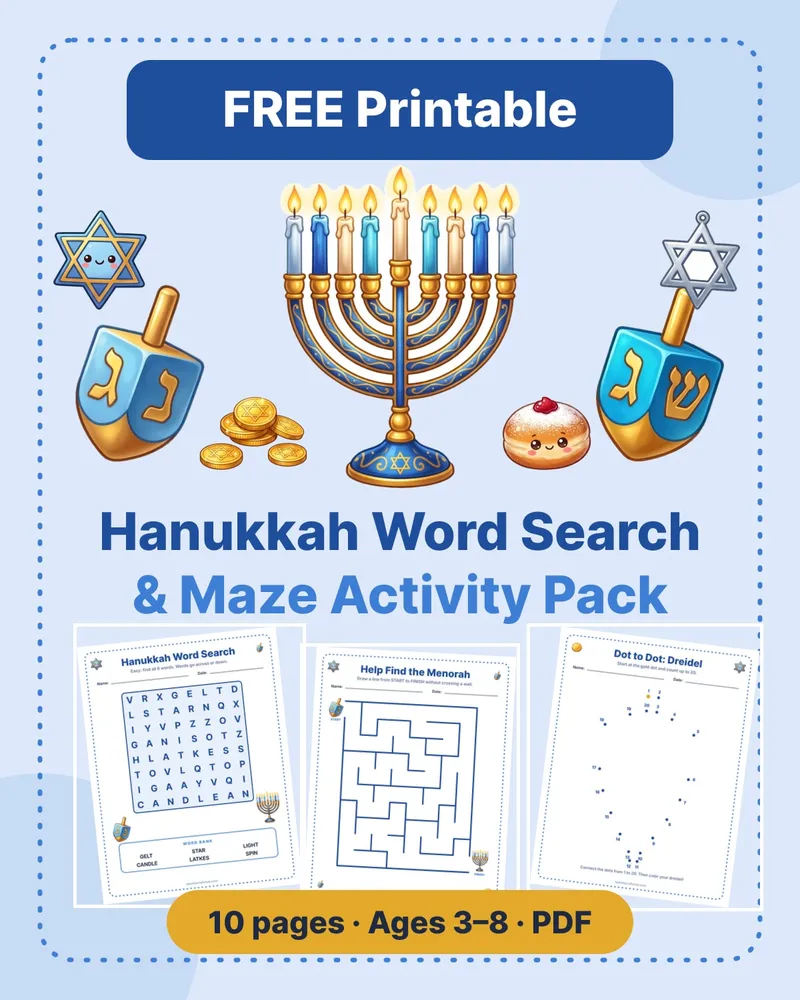
- Hanukkah Word Search & Maze Activity Pack: an easy 8x8 puzzle with words like GELT, STAR, and LATKES, plus a bigger 11x11 puzzle with HANUKKAH, MENORAH, and DREIDEL.
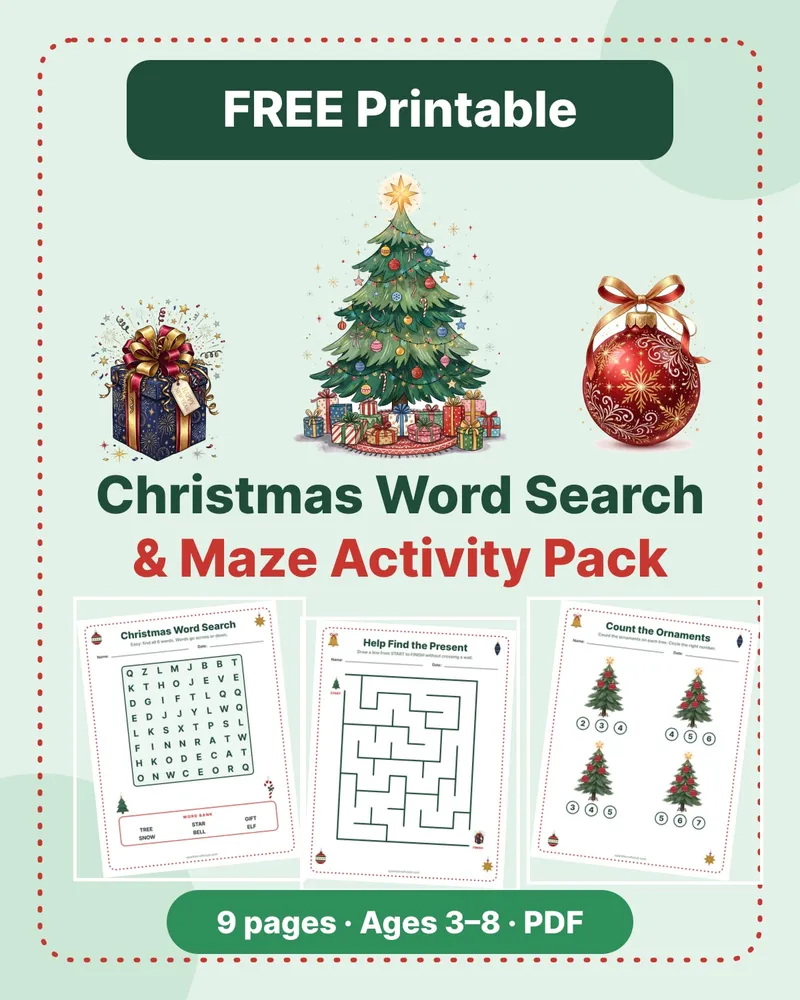
- Christmas Word Search & Maze Activity Pack: an easy 8x8 grid with TREE, STAR, and GIFT, and a bigger grid for older kids.
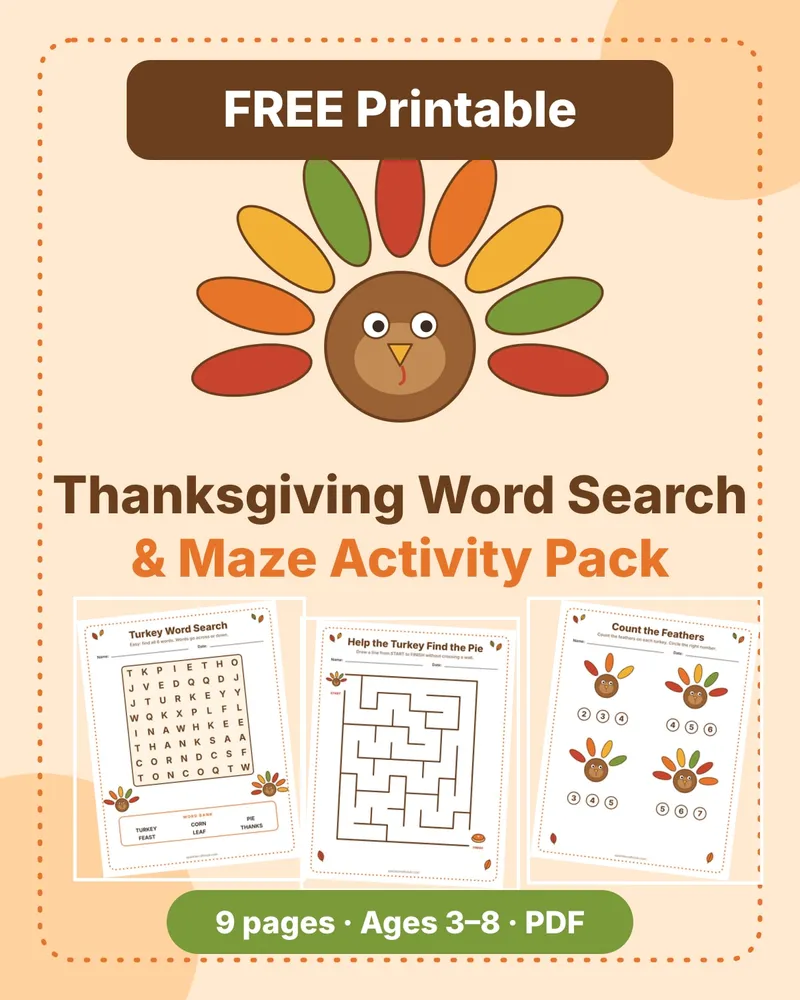
- Thanksgiving Word Search & Maze Activity Pack: an easy harvest puzzle and a bigger one, with answer keys.
 Preschool Activity Sheets
Hanukkah Word Search & Maze Activity Pack
10 Pages
Printable Hanukkah word searches, mazes, a count-the-flames page, dot-to-dot puzzles, and an eight-night tracker for kids ages 3 to 8.
 Preschool Activity Sheets
Christmas Word Search & Maze Activity Pack
9 Pages
Printable Christmas word searches, mazes, an ornament counting page, tracing paths, and a 24-day kindness countdown for kids ages 3 to 8.
 Preschool Activity Sheets
Thanksgiving Word Search & Maze Activity Pack
9 Pages
Printable Thanksgiving word searches, mazes, counting, and pencil-control pages for kids ages 3 to 8.
Using word searches in the classroom
Word searches fit into the first or last ten minutes of a class, or into a center rotation. They give early finishers something to do that is quiet and self-checking, since the answer key lets a helper or the student check the work. Put each puzzle in a clear sleeve and let kids use a dry-erase marker so you can reuse the same copy.
Add a writing step
After your child finishes a puzzle, ask them to pick one word and write it on a piece of paper, then draw a small picture of it. Or ask for a sentence that uses the word. This turns a quiet puzzle into a short spelling and writing exercise.
Frequently Asked Questions
- What age is a word search good for?
- Most kids can start around 5 or 6 once they know their letters and can read short words. With a grown-up helping, some younger kids enjoy hunting for letters or matching shapes.
- How big should a first word search grid be?
- An 8x8 grid with about six short words is a good first step. Words should run across or down only, and a word bank should be listed beside the grid.
- Do word searches help with reading?
- They give kids practice looking closely at letter order and matching words, which supports spelling and word recognition. They work best alongside regular reading, not as a replacement for it.
- Can I reuse a word search in my class?
- Yes. Slide the page into a clear sleeve or laminate it, and have students use a dry-erase marker. Everything on SparkleCraftClub is free for personal and classroom use.
Want more puzzles? Browse our free printable activity sheets and preschool activity sheets, or read our guide to printable mazes for kids.